Thursday, 21 February 2013

REVIEW: NERINA PALLOT- PLEASANCE THEATRE, GLASGOW


Talented Brit and Ivor Novello Award nominee Nerina Pallot continued her Lonely Valentine Club Tour in Edinburgh by proving once again that she is one of the UK’s finest singer-songwriters.
The intimate surroundings of Pleasance Theatre proved the ideal venue for the show, which saw Pallot ditch the band in favour of a completely solo show- just a piano, a guitar and her beautiful, disarming voice. And that only served to show just what a talent Nerina Pallot is. Without a full band behind, the spotlight shone more fiercely on the quality of the songs, a place where the Jersey-born star excels.
Plenty of tracks came from her best-selling album Fires, including breakthrough single Everybody’s Gone to War- which Pallot admitted she had gone through a period of not playing “like a petulant teenager”- along with Idaho and the incredible Human.
Mr King, Daphne and Apollo and History Boys may be heart breaking but they were also transporting, proving Pallot’s ability to penetrate the most intimate and private emotions. Lost in these poignant songs, her voice soared like a dove, and the simplicity of which she sang about the tragedy of war seemed to move the audience almost to tears.
Being a Nerina Pallot show, there were also the predictable ramblings between songs which are almost as entertaining as the tracks themselves. This time she voiced her opinion on reusable nappies as well as an offer to play at the wedding of any couple that had met at one of her gigs.


Treating us, among other things, to a live performance of the four new songs from her Lonely Valentine ClubEP, Pallot’s soaring vocals are perfectly accompanied by her solo piano and guitar-playing. A highlight among the new numbers is a hastily-written composition, Love Is An Unmade Bed, which dissects the ins and outs of a love-affair suffering from diminishing returns. The songs on the set list centre around the themes of unrequited love and the growing domesticity between couples, which Pallot jokingly insists are most certainly not about her marriage to record producer Andy Chatterley.
The new EP also includes an unexpected cover of CeCe Peniston’s 1992 single ‘Finally’, reworked into a stripped-back, piano ballad that manages to retain the joyful declaration of a new love and is, at the same time, underlined by a sombre soundscape. 
This may sound like an evening of lamenting lost loves, yet as the rosé flows onstage and Pallot shares the despair of her St Valentine’s Days past, there is a distinctly jovial atmosphere between the singer and the audience, who appreciate Pallot’s humorous, self-deprecating musings on love.
Pallot closed the show with radio favourite Put Your Hands Up but returned for an inevitable encore of Sophia, a ballad of desperate burning and unfulfilled love which has become a highlight of her concerts as she confesses: “Sophia, Sophia I’m learning that some things I can’t go without/And one of them is him.”


Sunday, 27 January 2013

DO ONLINE COURSES SPELL THE END OF CAMPUS LIFE?


Publishing, music, shopping and journalism have all recently been revolutionised by the internet. Next in line? Education. UK universities are now following the US phenomenon by offering free first-class tuition to anyone who can log on, anywhere in the world. But does this mean that traditional education is a thing of the past?


Sebastian Thrun, a German- born professor of artificial intelligence at Stanford University is the name behind Udacity, an online university which aims to provide mass high quality education around the world. The scheme is targeted at students in developing countries who don’t have access to traditional education or for students in the developed world who do but choose to study online. The choice seems simple: pay thousands of pounds a year for your education or get it free online?


The idea occurred to Thrun at the end of 2011. “I heard Salman Khan talk about the Khan Academy and I was just blown away by it.” 37-year-old Salman Khan, is the founder of the Khan Academy, more commonly referred to as the ‘classroom revolution.’ His online school has served up almost 200 million lessons through video and is growing rapidly thanks to an active community and support from the likes of Google and Bill Gates. The school boasts 3,400 short videos or tutorials, most of which Khan made himself, and 10 million students. "I was amazed by it," explained Thrun. "And frankly embarrassed that I was teaching 200 students. And he was teaching millions."


On the flipside, there are certain fundamental interactions that schools and universities facilitate that are very difficult to truly replicate online. It’s the personal nature of a teacher sitting next to you guiding you through a problem, or a lunch break with a fellow student, a class project in the library or an extra-curricular activity after school.


Edinburgh University was the first establishment in Scotland and the UK to offer Massive Open Online Courses (MOOCs) which are delivered via the Coursera partnership - a network of leading international universities which offer short undergraduate-level online courses free of charge. However, an increasing number of other UK universities seem to be employing the idea. King's College London, along with the Universities of Birmingham, Bristol, Cardiff, East Anglia, Exeter, Lancaster, Leeds, Southampton, St Andrews and Warwick have partnered with FutureLearn, a company set up by the Open University that will offer free, non-credit bearing courses to internet-users around the world.

MOOCs have attracted millions of users across the globe, and are especially popular in emerging economies – a key market place for UK universities. FutureLearn will promote UK institutions to international students, said Prof Martin Bean, vice-chancellor of the Open University.

"At the moment foreign students' perception of UK universities is: wonderful history, great tradition, really good teaching, but a bit boring.


"It's absolutely unacceptable that the number one or two brand for higher education in the world should be lagging in the areas of innovation in terms of Higher Education. We need to inject that front-foot, innovative flavour if we're to compete with the US."


The UK higher education industry, which is worth £14 billion, stands in the top five export earners for Britain. Universities minister David Willetts explained how the partnership – which has received cross-party support and involves universities from Scotland, Wales and England – will put the UK at the heart of online education.


Strathclyde University’s Myplace/Pegasus, a moodle-based learning system offers a combination of learning materials, incorporating the benefits of the Internet Age and the social and personal components that come with physical places of learning. Universities offer personalised advice from lecturers and tutors whose positive reinforcement is beneficial to students.

The future of education, both online and offline, will be won by those who understand that why, how and where people learn are not one­-size-­fits-­all questions. Figuring out how to get universities to accept MOOC classes for credit is a major thrust of the fast-growing, constantly changing online teaching industry at the moment. As Thrun concludes, “It’s my mission now; this is the future. There is no doubt about it.”

Sunday, 13 January 2013

FILM REVIEW: LES MISÉRABLES


Famously trashed by critics when it first appeared on the stage in 1985, the film version of Les Misérables has arrived. However, loosely based on Victor Hugo’s immense novel set among the poor in 19th century France, the production has thrived ever since. It now stands as the longest- running musical in the West End and the show has been relished by over 60 million people around the world.


Les Misérables follows the tale of Jean Valjean (Hugh Jackman), a proud and decent man imprisoned for nineteen years as a result of stealing a loaf of bread to prevent his sister’s family from starving. Once released, he is maliciously pursued by police officer Javert (Russell Crowe) for breaking the terms of his parole. However, Valjean assumes a new identity as he becomes mayor of Montreuil and a factory owner. This is where he meets Fantine (Anne Hathaway) whose daughter Cosette (Amanda Seyfried) will eventually fall in love with Marius (Eddie Redmayne) while Paris erupts in violence during the anti-monarchist uprising of 1832.

There are so many reasons not to even attempt the monumental task of converting this musical into a film but none were enough to deter Tom Hooper, the director who shot to glory following The King’s Speech in 2010. It is no secret that Hooper opted to shoot the actors singing live on set as opposed to lip-synching to a pre-recorded vocal.  It is a bold move to deliberately focus our attention on the singer, rather than the scene in general, by always filming them, their faces and their mouths in particular, in extremely close up shots.

Hugh Jackman as Jean Valjean and Anne Hathaway as Fantine.


This is remarkably effective when Anne Hathaway delivers Fantine’s ode to self-pity, ‘I Dreamed a Dream’. You may not be a fan of Hathaway, but as the desperate, martyred mother Fantine, deprived of hair, back teeth and dignity, her version of the song is delivered in one tremendous, tear-jerking take.


The cast have been the focus of great speculation- even more so than you would expect with ordinary blockbusters- on account of the demanding vocals required for each part. Fortunately, the decision to cast Hugh Jackman as Valjean turns out to be a wise one. Jackman’s stage work has been much admired, but with Les Mis, he has found a project that really puts that reputation to the test. His rendition of ‘Who am I’ was particularly effective, really drawing out Valjean’s desperation. Eddie Redmayne has pretty much only one facial expression, tremulously questing, but that’s appropriate for idealistic French student Marius, whom he makes touching, so you’re in there, wanting him to choose the forlorn Eponine (Samantha Barks) over the insipid Cosette.


Amanda Seyfried as older Cosette and Eddie Redmayne as Marius.


The star, however, more in his initial appearance than in later scenes, is Sacha Baron Cohen as the dodgy innkeeper M Thénardier, singing ‘Master of the House’ with unexpected gusto, in a surprisingly good French accent.


Primarily, there are three things that make this film appealing. Firstly, love both sacred and cruel, and its ability to transform and transcend. Secondly, our need to fight for change and social justice in a brutal world that resists revolution or is quick to undermine and divert it. Above all, Les Misérables is about holding on to hope in the most desperate conditions, and it climaxes in the victory of love in a context of political defeat.


http://sourcemagazine.org.uk/?p=3607 

Friday, 30 November 2012

FILM REVIEW: RISE OF THE GUARDIANS


Santa Claus (Alex Baldwin), the Tooth Fairy (Isla Fisher), the Easter Bunny (Hugh Jackman) and the Sandman make up the team of mythical creatures referred to as ‘The Guardians’ in the animated adaptation of William Joyce’s book, Rise of the Guardians. The myths of these characters build off our preconceptions to establish an imaginative world that contains endless possibilities and is visually stunning.

Directed by Peter Ramsey, written by David- Lindsay-Abaire and co-produced by Guilemro Del Toro, the film follows the Guardians (“it is our job to protect the children of the world”) as they join forces to defeat the evil Pitch Black (Jude Law), who threatens to strike fear in the hearts of the world’s children. In order to do this, the Guardians team up with the protagonist of the film, Jack Frost (Chris Pine) who begins the film as a newly born mythic creature desperate to seek talents other than creating ice, wind and snow.

The majority of Rise of the Guardians is filled with high speed flights across rooftops or huge, epic fights but that is not where its appeal lies. The film comes to life when our prior knowledge of these long-standing characters is used as a foundation to create the film’s world. We are all aware that the Tooth Fairy takes teeth and leaves money, but did you know that teeth contain our memories? Santa Claus builds toys at the North Pole, but did you know about his army? The Easter Bunny is associated with eggs, but how does he paint them? In every scene, the film enhances our preconceptions of what these characters can do.

Then there’s Frost, a character with no real backstory but that’s exactly the point. He’s enigmatic, uncertain of his place in the world and desperate for people to notice and accept him. Here, the film has built a character that is flawed, potentially dangerous, but very powerful with an affinity for good. His array of human characteristics is what keeps the film grounded in real emotions.


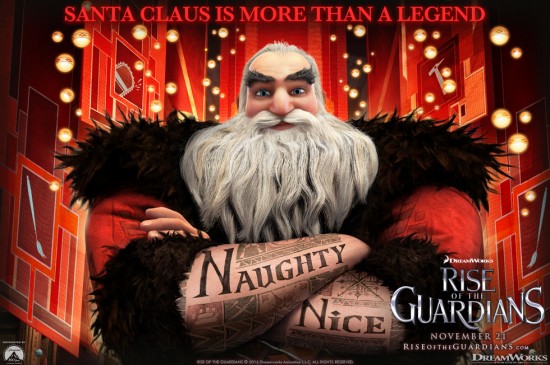
The film challenges the 21st century stereotype of Santa Claus.


The film makers have enlisted a talented group of actors to bring some inspired vocal interpretations of these classic characters. The best of these may be Baldwin’s spirited performance as North. This is not the warm, lovable St. Nick featured in the original Miracle on 34th Street.  This Father Christmas is a gregarious Russian bear of a man ready to wield his twin swords when needed. Fisher’s fairy is a charming, flirty sprite as she admires everyone’s oral hygiene. Pine’s Frost possesses some of the confidence of an extreme sports champion. His bravado masks his ambition to be appreciated by the world’s children (“Hey, I make snow days!”). As Pitch, Law is a sneering gentleman villain, an educated eloquent fellow who delights in his own wickedness.

The writing is intelligent as it attempts to twist Christian morality into cartoon dimensions without ever referring to God, Jesus or the origin of Christmas. The only thing it forgot to do is make us care. Without developing relationships between the characters through smaller human moments, it's difficult not to feel discontented with the excitement of fantasy - and just a little hungry for something more. 

Wednesday, 21 November 2012

TV REVIEW: THE HOUR (BBC)


The BBC drama about a BBC news programme returned last week, and it's never felt more relevant.

In the first episode of The Hour’s second series, loathsome political accomplice, Angus McCain advocates that “A lie has no legs. A scandal - now, that has wings.” With slicked-back hair and hinted-at homosexuality, actor Julian Rhind-Tutt injects the lines with the hostility and malice that those who avidly watched the drama’s first series have come to expect from him. His beloved Prime Minister Eden might be gone, but McCain wants to convey from the outset that he still exerts power in the shadowy world of Westminster. And in speaking these words, he’s also setting up a series’ worth of plot points, and reassured us that writer Abi Morgan has decided to stick with a successful formula.

Nine months have passed since the show-within-a-show, The Hour, started on the BBC, and a new head of news is changing the course of events. Hector Madden (Dominic West) is still lead host and Lix Storm, (Anna Chancellor) remains as producer, but last year’s ordeal mixed with his father’s death has led Freddie Lyons (Ben Whishaw) away to Paris for the time in between. Missing her right hand man, we can instantly tell that Bel’s passion for the show has decreased since last year.  Freddie soon returns older, wiser and better poised as a meaningful rival (and co-host) to Hector for the status of the show's alpha male. 

Ben Whishaw as Freddie Lyon, The Hour's home affairs correspondent.


It was impossible for Morgan to know when writing The Hour’s second series that it would air in a week when the real-life BBC has been encompassed in scandal that hinged on inadequate management and investigative journalism gone wrong. The Jimmy Savile affair and the Lord McAlpine disaster are hardly equivalent to having Soviet spies wandering around the corporation's canteen, but it still feels more topical than a drama should be observing producer, Bel Rowley (Romola Garai) wrestling with the problems of sourcing and news management, and worrying that ITV’s competitor programme, Uncovered, has stolen her idea for a hard-hitting investigative news show and is delivering it better than she is.

The changing role of women is at the very centre of The Hour; the character of Bel Rowley is based on the real-life BBC producer Grace Wyndham Goldie. As the show focuses on the making of a BBC programme about contemporary events, The Hour is very much about Britain: the British establishment attempting to adapt to or control a world on the edge of dramatic change. The first series was set against the backdrop of the Suez crisis; the current series, a year later in 1957.


Two fairly well-known faces have joined the show this year, in the form of Peter Capaldi (The Thick of It;Torchwood) and Hannah Tointon (The Inbetweeners; Switch). Both make wonderful first impressions, with the former joining the Hour team and the latter acting as the catalyst for Hector’s troubles. Overall, this episode was a great return for a series that was, at times, too complicated to enjoy. There’s more of a focus on characters and relationships than on outside scandals and world events, and this gives it the potential to be even more successful than the first series.

The Hour continues on BBC Two every Wednesday at 9pm


http://www.bbc.co.uk/iplayer/episode/p00wkh14/The_Hour_Series_2_Episode_1/


Saturday, 3 November 2012

ONE BILLION AND COUNTING: IS FACEBOOK REALLY CONNECTING PEOPLE?


Facebook has hit a significant new milestone: the social network now has one billion users.

Just as Facebook’s founder, Mark Zuckerberg announced its one billion users on the 14th of September, the site released its very first advertisement entitled ‘The Things That Connect Us.’ The advertising campaign will air in thirteen countries, including Spain, Mexico, Russia, Brazil and the US.

The 90 second advert, made by Wieden and Kennedy (well known for its Nike advertising fame), aims to reveal the human aspect of social networking and the role Facebook plays in maintaining and developing human connections.

The advert compares Facebook to chairs, bridges, basketball and other things that unite people and states that Facebook is like a “great nation”, a “place where [people] belong.”
Facebook's new advertisement compares the site to chairs and various other objects which connect people.


“What we’re trying to articulate is that we as humans exist to connect, and that we at Facebook facilitate and enable that process,”  head of Facebook’s consumer marketing, Rebecca Van Dyck, reported. “We make the tools and services that allow people to feel human, get together, open up.


"Even if it’s a small gesture, or a grand notion — we wanted to express that huge range of creativity and how we interact with each other.”


To date, Facebook has documented 140.3 billion friend connections, 1.13 trillion likes and 219 billion shared photos since it commenced in February 2004. Over 300m photos are uploaded daily and 62.6m songs played.

"Helping a billion people connect is amazing, humbling and by far the thing I am most proud of in my life," Zuckerberg wrote in a Facebook timeline update on his personal account. "I am committed to working every day to make Facebook better for you, and hopefully together one day we will be able to connect the rest of the world too."
But does Facebook really connect people? The company is beginning to be acknowledged as dictator like. If we write on someone’s timeline, who else will see it? If we comment on someone’s status, whose newsfeed will it show up in? Occasionally, it seems like Facebook is a hidden microphone, threatening to expose what we really want to say. Deprived of the ability to open up, connecting with friends is a challenge.

In the same way, the social network can create a false sense of community. Everyone is called your ‘friend.’ What is a ‘friend’? On Facebook, what they call a ‘friend’ is someone who can view your profile and comment on your statuses and photos, and vice versa. A ‘friend’ on Facebook can be someone you’ve never met. It can be a friend of a friend, someone you have only heard of, or someone you have only met once or twice. In the real world, however, a friend is someone you have a deep relationship with. Generally, it is someone you have looked in the eye and had a conversation with. It is not difficult to acquire over 100 Facebook ‘friends’ but none of them ever grow into real quality friends. It is only too easy for Facebook to replace an old fashioned phone call. The simple person to person approach. Instead, it is a world where inhibitions are few. People are ever more vocal about their opinions and ‘friends’ are connecting in a negative way.
Despite receiving negative press, reaching one billion users a month is a significant achievement for Zuckerberg.

In a more positive light, Facebook can be beneficial to businesses. Samuel Junghenn, founder of the Digital Marketing Agency, Think Big believes that: “businesses need to stop focusing on the negative press around Facebook and start focusing on engaging. Facebook has a massive market share of all online consumers and any business would be remiss not to use it as a platform to drive traffic and customers.”

In order to solve these conflicting points of view, Facebook must remember to centre around friendship; focus on building meaningful experiences with friends. To develop that, the social network can create an environment of trust, security and of true connections as Zuckerberg concludes that “the need to open up and connect is what makes us human. It’s what brings us together. It’s what brings meaning to our lives.”


EVAN ROBERTSON: THE ILLUSTRATED QUOTATION PROJECT


“The best thing about paperbacks (apart from the smell, of course) [writes Evan Robertson, a writer and illustrator based in New York], is that when a little jewel of a sentence grabs you, you can underline it… Underlining is the original ‘interactive’ media. Think of it as a hyperlink that redirects to your own thoughts, and like a hyperlink, it can leave the rest of the story behind and open up a new window of ideas, insights and musings.”

That’s the spirit of this series of illustrations.

His plan is to complete 50 posters a year, having done 24 already. Among those are lines from literary giants including Oscar Wilde, Vladimir Nabokov, Ernest Hemingway, Jane Austen and Emily Brontë.

Robertson describes his work as “inspired by my love of literature, word play and straight-shooting language,” and indeed, these poignant prints are filled with visual puns which tortured artists, English Literature students and bookworms will adore.

Robertson extracts sparks of thought which – after reflecting upon them – could lead to more sparks themselves.

"Lie to me by the moonlight. Do a fabulous story." from F. Scott Fitzgerald's short story, The Offshore Pirate.


"Curiosity is insubordination in its purest form" from Vladimir Nabokov's Lolita.
"Whatever our souls are made of, his and mine are the same" from Emily Bronte's Wuthering Heights.
"I am half agony, half hope" from Jane Austen's Persuasion.


Visit Robertson’s Etsy store Obvious State, to purchase the posters.